
Spikenard in the Bible shows up in only a handful of places, but one of them stops the Gospel narrative cold. A woman walks into a dinner party, breaks open a jar worth a year's wages, and pours the whole thing over Jesus. The room fills with the smell of it. Someone objects. Jesus does not let the objection stand. That single scene is where GodScent's Alabaster fragrance starts, and it is worth slowing down to read closely, because the Gospels themselves do not all tell it quite the same way.
The Scene at Bethany
The core account appears in two of the Gospels, in almost identical language. Mark's version is the shorter one:
"And being in Bethany in the house of Simon the leper, as he sat at meat, there came a woman having an alabaster box of ointment of spikenard very precious; and she brake the box, and poured it on his head." (Mark 14:3, KJV)
Matthew tells the same story, in the same house, with the same jar (Matthew 26:6-7). In both accounts, the woman is not named. She simply appears, breaks the alabaster jar, and pours the spikenard over Jesus' head. The people at the table are indignant — Matthew says "his disciples," Mark says "some that had indignation within themselves" — because the ointment could have been sold for a great deal and given to the poor. Jesus answers that she has done a good work, and that what she has done "shall also be told for a memorial of her" (Mark 14:9).
A Second Account, and the Name Attached to It
John's Gospel records what most readers take to be the same event — or one very much like it — six days before Passover, at a supper in Bethany. Here the woman is named:
"Then took Mary a pound of ointment of spikenard, very costly, and anointed the feet of Jesus, and wiped his feet with her hair: and the house was filled with the odour of the ointment." (John 12:3, KJV)
This is Mary of Bethany — sister of Martha and Lazarus, the same Mary who earlier sat at Jesus' feet to listen while Martha served (Luke 10:38-42). In John's account it is specifically Judas Iscariot who objects to the cost (John 12:4-5), and John adds the detail that gives the story its full sensory weight: the fragrance did not stay contained. It filled the house. Everyone at that table smelled what she had done, whether they understood it or not.
Mark and Matthew do not name the woman at Simon's table, and readers across church history have debated whether that account and John's are the same event told two ways, or two separate anointings. What all three Gospel writers agree on is the object at the center of the story: a jar of spikenard, alabaster, broken open, poured out completely, with nothing held back for later.
What Spikenard Actually Was
Spikenard — nard, in some translations — was an aromatic oil derived from a plant native to the Himalayas, a very long way from Judea. That distance is part of why it was so costly. John records that the ointment used by Mary was worth three hundred pence (John 12:5), which by the common day-wage of a laborer at the time represented most of a year's income. This was not a modest household spice. It was, as Mark puts it, "very precious" — a luxury import, the kind of thing a household might own exactly once.
The Alabaster fragrance keeps spikenard as its most prominent note for that reason: it is the one ingredient every Gospel account of this story names outright, and it is the ingredient that makes the gesture what it is. Pouring out water is not a story. Pouring out a year's wages, in one uncalculated motion, is.
Why the Jar Had to Break
The alabaster jar itself carries its own weight in the story. Alabaster containers were the standard vessel for the most expensive ointments in the ancient world, sealed at the neck so the contents stayed pure until use. To open one properly for a small amount meant snapping the thin neck of the jar — an irreversible act. There was no pouring "a little" and saving the rest. Once the jar was broken, the whole thing was spent.
That detail is why the story reads as recklessness to the people watching. A more careful woman might have poured out a portion and kept the vessel intact for later use or resale. She broke it entirely. The gift was not partial, and it was not undone.
The Objection, and the Answer
In every version of this story, someone at the table does the math. Three hundred pence. A year's wages. Given to the poor, that much money could have done real good — and the objection is not wrong on its own terms. Jesus' answer does not dispute the value of the ointment or the value of caring for the poor. He reframes what the act meant: she had done it, he says, "against the day of my burying" (John 12:7) — an anointing that, whether she fully understood it that way or not, arrived just before his death and burial, when there would be no more time for it.
That is the tension GodScent built into Alabaster from the start: beauty and burial in the same bottle. Extravagance is not the same as waste, and this is the story Scripture uses to make that case as plainly as it ever does.
Wearing the Story
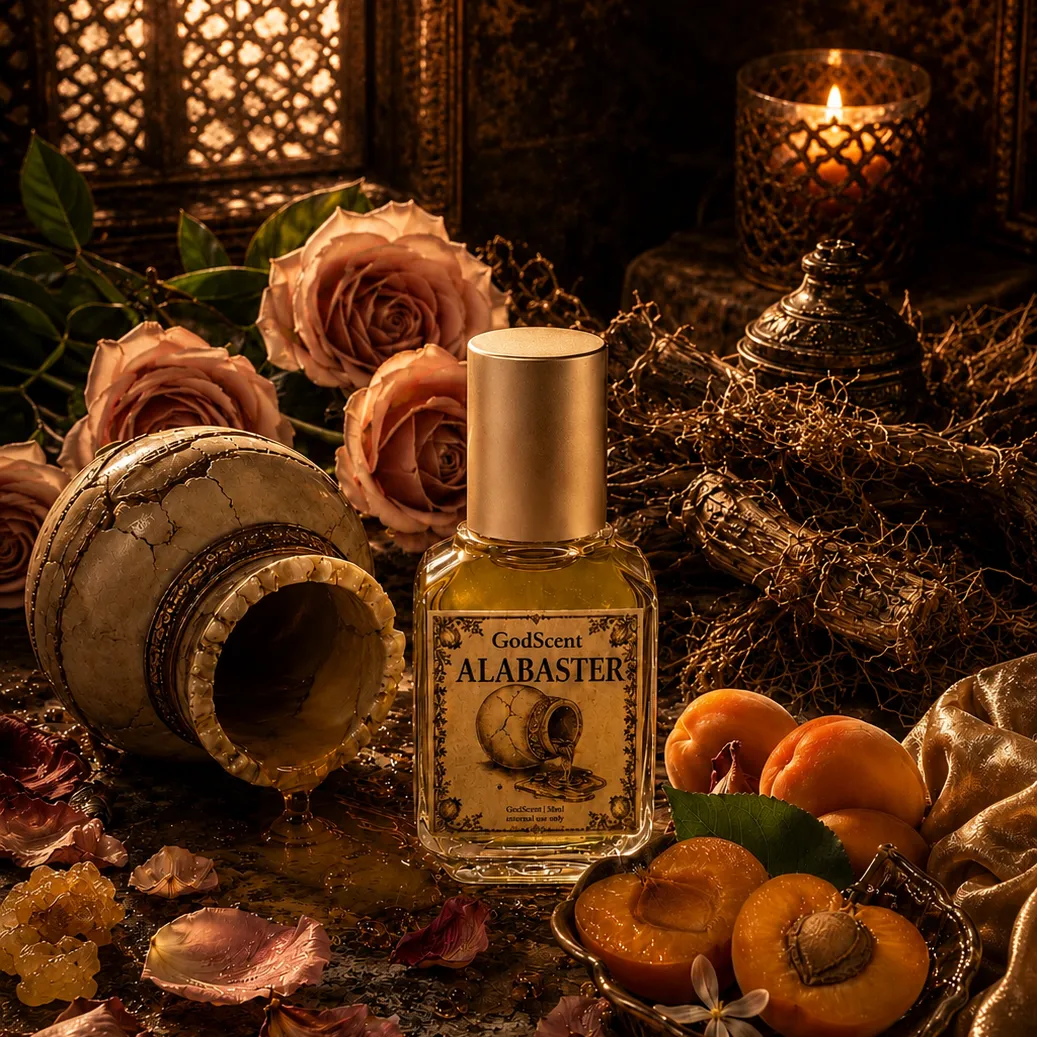
Alabaster opens with davana and gold, jasmine and gardenia bursting — the jar cracking open. The heart carries the spikenard itself, alongside labdanum, orris, rose, and lily of the valley. It settles into vetiver, benzoin, and ambrette, warm skin pressed against sacred ground. None of the notes are invented for effect; they follow the shape of the story, from the crack of the jar to what's left once the room has gone quiet.
If you want the fuller sweep of where fragrance shows up across Scripture — not just this one scene — the Journal's guide to perfume in the Bible walks through every major appearance, spikenard included.
Frequently Asked Questions
Is spikenard mentioned anywhere else in the Bible?
Yes. Spikenard also appears twice in the Song of Solomon (1:12 and 4:13-14), where it is one of several fragrant plants named in a garden of aromatics — pomegranate, saffron, calamus, cinnamon, frankincense, myrrh, and aloes among them (Song of Solomon 4:14). The Gospel accounts in Mark, Matthew, and John are its most well-known appearances.
Was Mary of Bethany the same woman as the "sinful woman" in Luke 7?
Not according to most readings of the text. Luke 7:36-50 tells a separate story — a different house, a different city, an unnamed woman described as "a sinner," anointing Jesus' feet with tears and ointment. It has often been conflated with Mary of Bethany's story in tradition and art, but Luke does not identify the two women as the same person, and the Gospel of John clearly names the Bethany account as Mary's.
Did every Gospel writer record this event the same way?
No. Mark and Matthew place the anointing at the head, in the house of Simon the leper, with the woman unnamed. John places it at the feet, names Mary, and adds that the fragrance filled the house. Whether these describe one event remembered differently or two separate anointings is something scholars still discuss; what stays constant is spikenard, alabaster, and an extravagant amount poured out at once.
What does GodScent's Alabaster fragrance smell like?
It opens with davana and gold, jasmine and gardenia bursting open. The heart holds spikenard — the note the Gospel accounts name directly — with labdanum, orris, rose, and lily of the valley. It dries down into vetiver, benzoin, and ambrette. You can read the full story and notes on the Alabaster product page.