
The frankincense and myrrh meaning most people know starts and ends with a manger: two of the three gifts the magi carried to Bethlehem, alongside gold, for a child they had traveled a long way to find. That much is familiar. What gets lost is that frankincense and myrrh are not interchangeable in Scripture — they show up in different rituals, for different purposes, and only rarely together. Understanding where each one actually belongs is what makes the magi's gift so strange, and so specific.
The Gift in Matthew's Gospel
The account is brief. Matthew records it in a single verse:
"And when they were come into the house, they saw the young child with Mary his mother, and fell down, and worshipped him: and when they had opened their treasures, they presented unto him gifts; gold, and frankincense, and myrrh." (Matthew 2:11, KJV)
Matthew does not explain the gifts. He simply lists them, and lets the reader carry whatever they already know about frankincense and myrrh into the scene. Christian tradition has long read symbolic weight into the three: gold for a king, frankincense for a priest or for worship, myrrh for a mortal who would die. Scripture itself never states that interpretation directly — but the rest of the Bible's use of frankincense and myrrh makes the myrrh half of it, at least, hard to avoid.
Frankincense: Built for the Altar
Frankincense's primary role in the Hebrew Scriptures is as incense — burned, not worn or applied to skin. Exodus 30 gives the Lord's instructions for the incense that would burn in the tabernacle:
"And the LORD said unto Moses, Take unto thee sweet spices, stacte, and onycha, and galbanum; these sweet spices with pure frankincense: of each shall there be a like weight." (Exodus 30:34, KJV)
That incense was reserved entirely for worship — the text goes on to forbid making it for common, personal use (Exodus 30:37-38). Frankincense also appears as part of the grain offering in Leviticus 2:1-2, where a portion of it was burned "for a sweet savour unto the LORD." Its whole biblical identity runs toward the altar: something offered upward, consumed in fire, meant for God and not for the giver to keep.
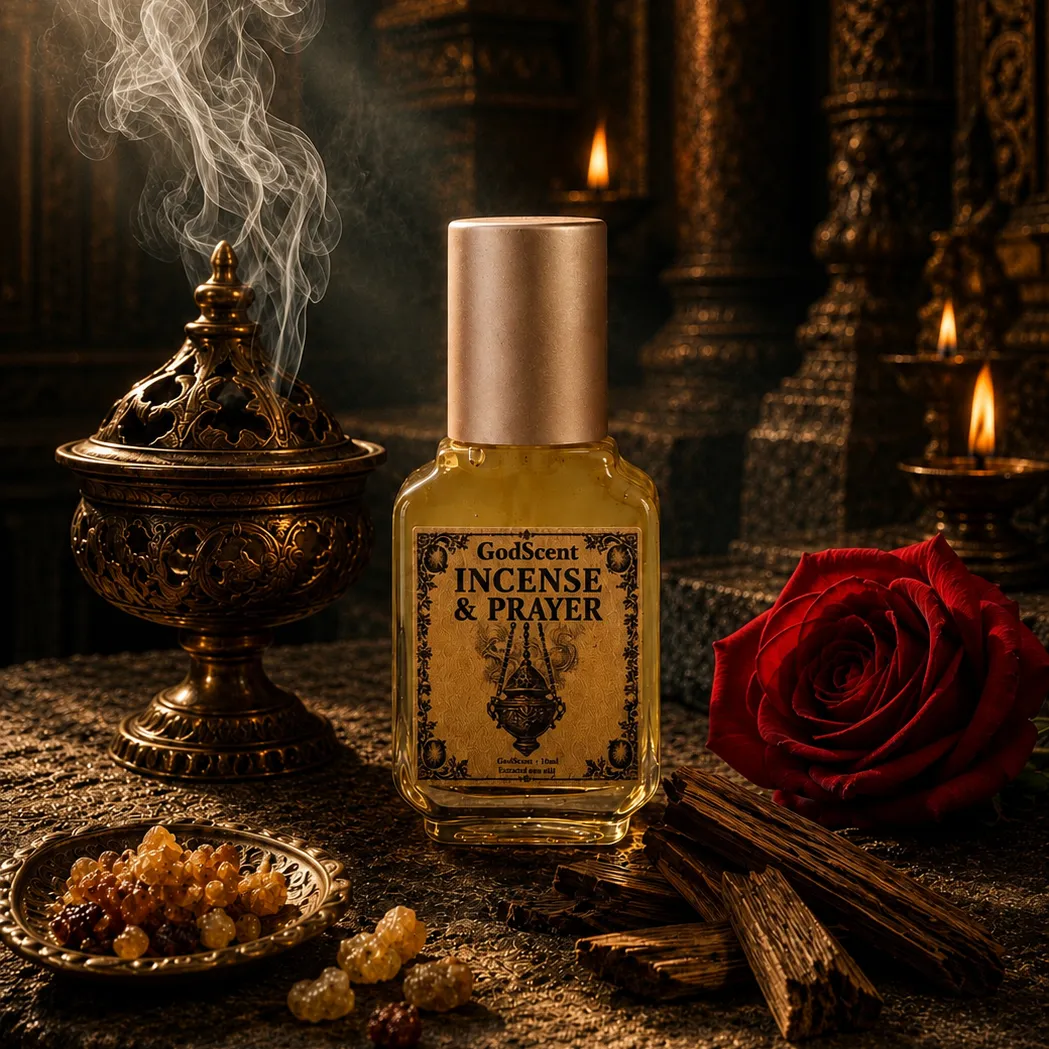
This is the same logic behind GodScent's Incense & Prayer, which carries frankincense as one of its most prominent notes alongside oud and myrrh. The fragrance is built to evoke rising smoke rather than a garden or a jewelry box — an incense and prayer fragrance in the most literal sense.
Myrrh: Built for the Body
Myrrh's biblical uses run in the opposite direction — not upward in smoke, but onto and around the body. It was a core ingredient in the holy anointing oil described in Exodus 30:23-25, blended with calamus, cinnamon, and cassia. It shows up in Esther's yearlong beauty preparation: "six months with oil of myrrh" before she was presented to the king (Esther 2:12). And most strikingly, it appears at Jesus' burial, brought by a man most readers only meet in this one scene:
"And there came also Nicodemus, which at the first came to Jesus by night, and brought a mixture of myrrh and aloes, about an hundred pound weight." (John 19:39, KJV)
A hundred pounds is an extraordinary quantity — royal, even, for a burial. Myrrh's association with embalming and burial spices runs through both testaments, which is exactly why a birth-narrative gift of myrrh reads, in hindsight, like foreshadowing. A king born to die was given, among his first gifts, the spice used to prepare a body for the grave.
Why They're Rarely Paired
Outside Matthew 2:11, frankincense and myrrh appear together only occasionally, most notably in the Song of Solomon, where a longer list of aromatics includes both: "spikenard and saffron; calamus and cinnamon, with all trees of frankincense; myrrh and aloes, with all the chief spices" (Song of Solomon 4:14). But in the ritual law of Exodus, they are kept apart on purpose — frankincense in the incense recipe, myrrh in the anointing oil, two different formulas, two different uses, both restricted from ordinary personal use (Exodus 30:32-33, 30:37-38).
That is part of what makes the magi's gift so pointed. They did not bring one all-purpose "holy fragrance." They brought the ingredient of worship and the ingredient of burial, side by side, to a child whose life would eventually require both.
Frankincense, Prayer, and Psalm 141:2
One more thread runs through frankincense's biblical use: its long-standing association with prayer itself. The psalmist asks that his own prayer be received the way incense is received at the altar:
"Let my prayer be set forth before thee as incense; and the lifting up of my hands as the evening sacrifice." (Psalm 141:2, KJV)
Revelation picks up the same image at the other end of Scripture, describing an angel with "much incense, that he should offer it with the prayers of all saints upon the golden altar," where "the smoke of the incense, which came with the prayers of the saints, ascended up before God" (Revelation 8:3-4). Incense rising and prayer rising become, in these two passages, nearly the same picture. That is the atmosphere Incense & Prayer is built to hold — not a scent that reminds you of a sanctuary, but one built from the same materials Scripture uses to describe prayer ascending.
If You're Shopping, Not Just Reading
Frankincense and myrrh's long association with meaningful, considered gifts makes them a natural starting point if you're choosing a fragrance for someone else. The Gifts guide walks through which GodScent fragrance fits which story — Incense & Prayer among them, for the person in your life who prays more than she talks about it.
For the fuller picture of where fragrance shows up across the whole of Scripture, the Journal's guide to perfume in the Bible covers spikenard, myrrh, frankincense, and the rest in one place.
Frequently Asked Questions
Does the Bible say frankincense and myrrh symbolize anything specific?
Matthew 2:11 lists the gifts without explaining them. The symbolic reading — frankincense for worship, myrrh for burial — comes from how each substance is used elsewhere in Scripture, not from an explicit statement in the birth narrative itself.
Were frankincense and myrrh expensive in the ancient world?
Yes. Both were resins harvested from trees native to southern Arabia and the Horn of Africa, transported long distances by trade caravan, which made them costly imports comparable to gold in value at various points in antiquity.
Is myrrh the same as the oil used in the holy anointing oil?
Myrrh was one ingredient among several. Exodus 30:23-25 lists pure myrrh, sweet cinnamon, sweet calamus, and cassia blended into olive oil to make the anointing oil — a specific, restricted formula, not myrrh alone.
What does GodScent's Incense & Prayer fragrance smell like?
It opens with black pepper and cypress, oud, and elemi. The heart carries frankincense with rose and neroli. It dries down into birch tar, guaiacwood, and benzoin, fused to skin with ambroxan. Full notes and story are on the product page.